Soft Mozart
Free Introductory Piano Lesson for Adult Beginners
Soft Way to Mozart® · Hiner Method · Soft Mozart 5
Where to Begin
Today you’ll read your first notes and play Happy Birthday with the orchestra.
Before you begin, set aside what you learned about music in school for a moment. Start with what you can see and hear for yourself.
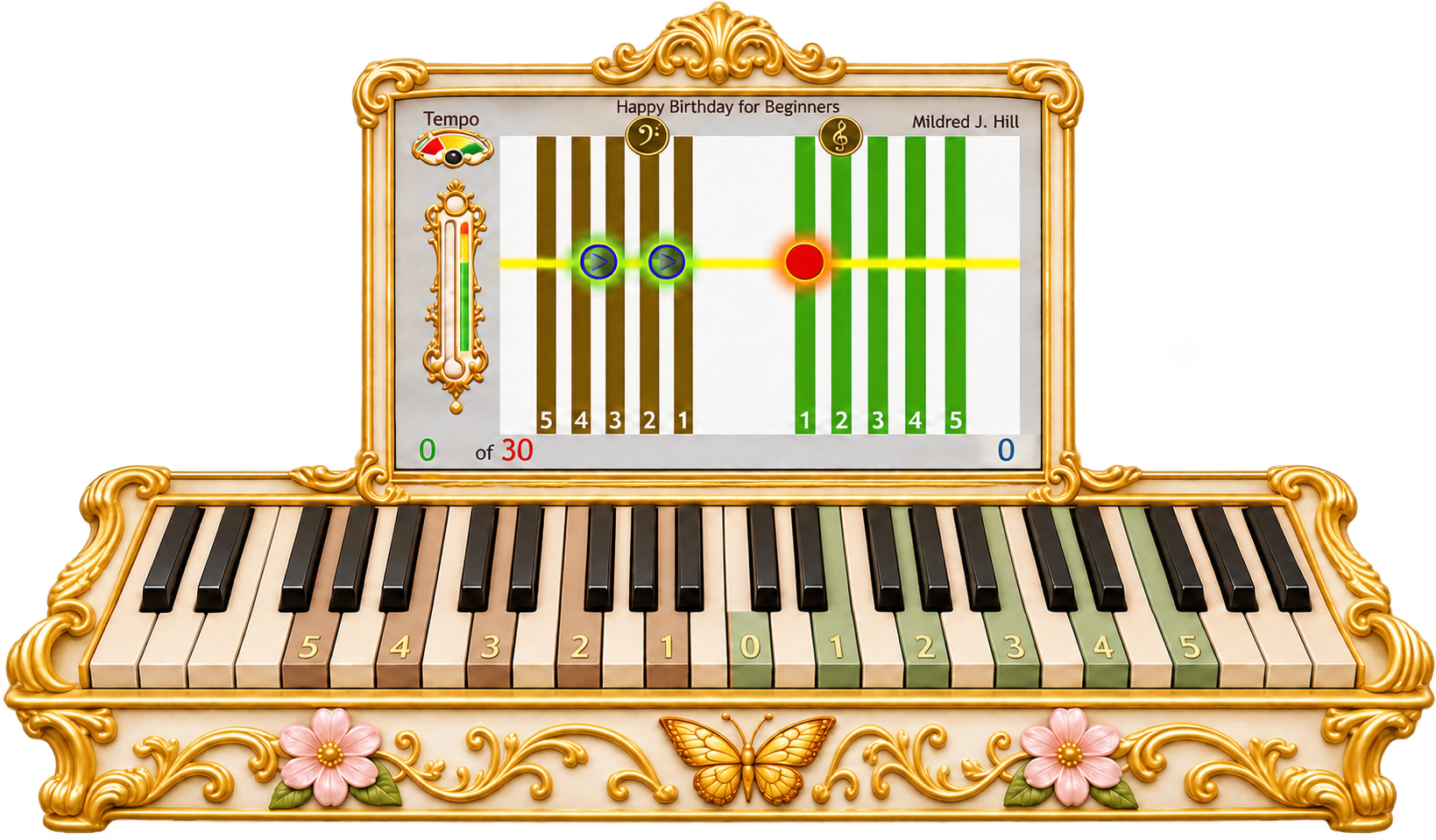
Find the butterfly. The key marked 0 just above it is middle C. Now look at the screen. Count the five green lines on the right and the five brown lines on the left. On both sides, count outward from the center. Can you see the symmetry? Both sets of lines share a single center.
The black keys help you find your way around a piano. How do you find your way around written music? Guido of Arezzo taught singers to recognize pitch by a note’s position on a line or in a space. Trace the pattern in either direction from middle C: line, space, line…
Music literacy begins here: you can write down a sound as a note and bring that note back to life as sound.
Imagine the musical system as a planet. Its clefs, tone colors, and instruments are its continents. As you explore them in this lesson, keep the whole planet in view.
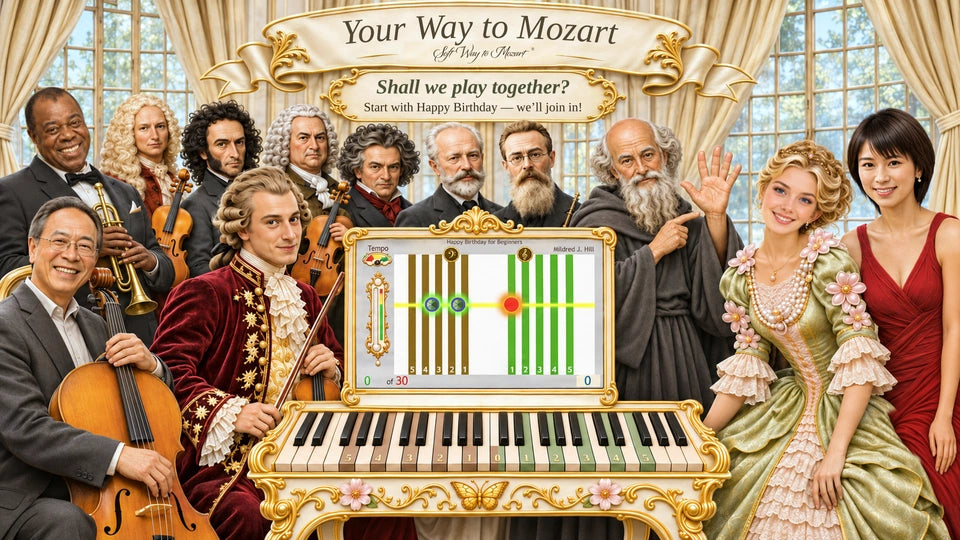
For adult beginners
 Play Happy Birthday with the orchestra!
Start at a slower tempo.
Play at concert tempo when you’re ready.
Read notes, train your ear, and play Happy Birthday with an orchestra.
Try the activities at the keyboard, notice what you can already do, and choose your next step. Take the lesson over several sessions if that suits you. Return to the same activities and compare your attempts.
Before you begin
Connect your MIDI keyboard or digital piano to your computer. The Technology Lesson will help you check that the program receives what you play. Press F1 in a module to see its controls.
Working with the demo
Spend 45 seconds on each game attempt. Try all the available demo levels in Guess Key and Fruit Lines. The full course sequence is available in Soft Mozart 5.
Try the game opens the module directly. Practice and save your results takes you to My Learning. Keep your own notes so you can compare like with like.
1. What can I already do in music?
“If I had started as a child, could I have become a musician?” Adults ask this before their first lesson and when they return after years away. Here is a question you can answer for yourself today. What can I already do in music, and what can I learn next?
This lesson is for first-time players, adults returning to the piano, and parents who want to try the activities their children are learning. Each of you can find a starting point at the instrument.
Is it too late to start?
Adults can learn new movements and skills. In a year-long study of older adults with little prior musical training, the beginners who practiced piano improved their fine motor skills more than the group that took part in music-listening activities. [10]
Your first attempt gives you a baseline. A second attempt shows you what changed when you practiced.
Age alone gives you no reason to rule yourself out. A first attempt tells you where you are starting today. Keep it as a point of comparison.
What can you find out in a first lesson?
You might hear the sound you want and still need time to find the key. You might play either hand confidently on its own and stop when the hands come together. Each problem calls for a different kind of practice.
A single sticking point can feel like a lack of musical ability. Try separating the skills involved before drawing a conclusion.
- Eye–hand coordination. Connect the note you see with an action at the keyboard.
- Fine motor control. Choose the finger you need, press the key, hold it, and release it.
- Coordination between the hands. Notice what each hand can do and where playing together gets harder.
- Ear training. Listen for the pitches and relationships you can already recognize.
- Rhythm. Keep a pulse and reproduce notes of different lengths.
Use measurements to choose what to practice
Think of the displayed numbers as information, like a reading on a thermometer. In the appropriate mode, Soft Mozart records how many notes were credited and how long the task waited for your actions. Compare these readings with what you heard and felt as you played.
Suppose you play the same passage twice with one hand and the same settings. All eight notes are credited both times. On the second try, you find the key sooner at the place where you had stopped. That is measurable progress. If you hurry and lose accuracy, the result tells you where to slow down and work again.
Keep the settings in your notes. Only a repeat under the same conditions tells you how your response to that particular task changed with practice.
What do you gain from trying?
Playing lets you hear music from the inside. You notice how a tune moves, where a note lasts longer, and what a pause does. Those details become easier to hear in someone else’s performance.
You also learn what helps you practice. One person needs to isolate a finger motion, another needs to listen more carefully to the rhythm, and another needs a shorter passage. Once you can name the difficulty and repeat the task, even a short practice session has a purpose.
If you are a parent, trying the exercise yourself makes it easier to give a child time to think, find a key, and complete the action independently. At the end of the lesson, write down one thing you can do now and one thing you want to try next.
If you teach or support a child, notice the pause between recognizing a note and being ready to press and release its key. A child can already know the answer and still need that time. Give them room to finish their own attempt.
For a music lover, playing offers another way into a familiar piece: hear the result of your own action and gradually extend what you can do. Finish the lesson by naming one thing you can already do and one thing you want to learn next.
2. The Kingdom of Tune and Harmony
Seven scale degrees, seven musical characters
Each scale degree has a role in relation to the tonic, the tonal center. In a melody, those relationships help create movement, stability, tension, and resolution. In harmony, notes combine to form chords whose roles depend on their structure and musical context.
The tonic is scale degree I, the dominant is V, and the subdominant is IV. These names also describe chord functions in harmony. Hearing scale degree V by itself is different from hearing a dominant chord. [11] [12]
These relationships underlie a great deal of classical, folk, and popular music. Listen for them in tunes you already know.
Middle C and the tonic
The butterfly marks middle C, a fixed reference point on the keyboard. Listen to a melody and you can hear a different kind of reference point: the tonic, the note that feels like home. In C major, the tonic is C. In G major, it is G. The butterfly stays under the same key in both cases.
Why the Kingdom of Tune uses characters
In Soft Way to Mozart®, the seven scale degrees become characters with their own roles. The Kingdom of Tune gives you images, songs, stories, and games that connect a musical concept with what you can hear, read, and play.
Each character has a personality, a purpose, and relationships with the others. Behind each story is a musical idea that you can learn to hear and eventually recognize at the keyboard. Our original songs, stories, and interactive games introduce these ideas through listening and playing.
As you learn to hear these relationships, you can use them to:
- Choose chords to accompany a familiar tune.
- Follow a chord progression by ear.
- Transpose a tune into a different key.
- Compose melodies of your own.
- Improvise on a familiar melody.
- Recognize how a piece of music is put together.
In this lesson we begin with one character.
Meet Queen Tonic
Queen Tonic represents scale degree I. In C major, the tonic is C. In D major, it is D. In G major, it is G. The tonic is a musical role that a note can take in a particular key.
The tonic can appear at the beginning, in the middle, or at the end of a melody. Listen especially to the sense of arrival when a phrase returns to it. In the song and animation, listen for how the Queen describes the first scale degree, the tonal center, and its relationship with the dominant.
Listen to Queen Tonic’s song. The lyrics describe the tonic as the first scale degree and the “home” of a key.
Hear the tonal center in Happy Birthday
The version you will play is in F major. F is Queen Tonic (I), B♭ is Princess Subdominant (IV), and C is King Dominant (V). In the lesson’s solfège naming, these are Fa, Ti-flat, and Do.
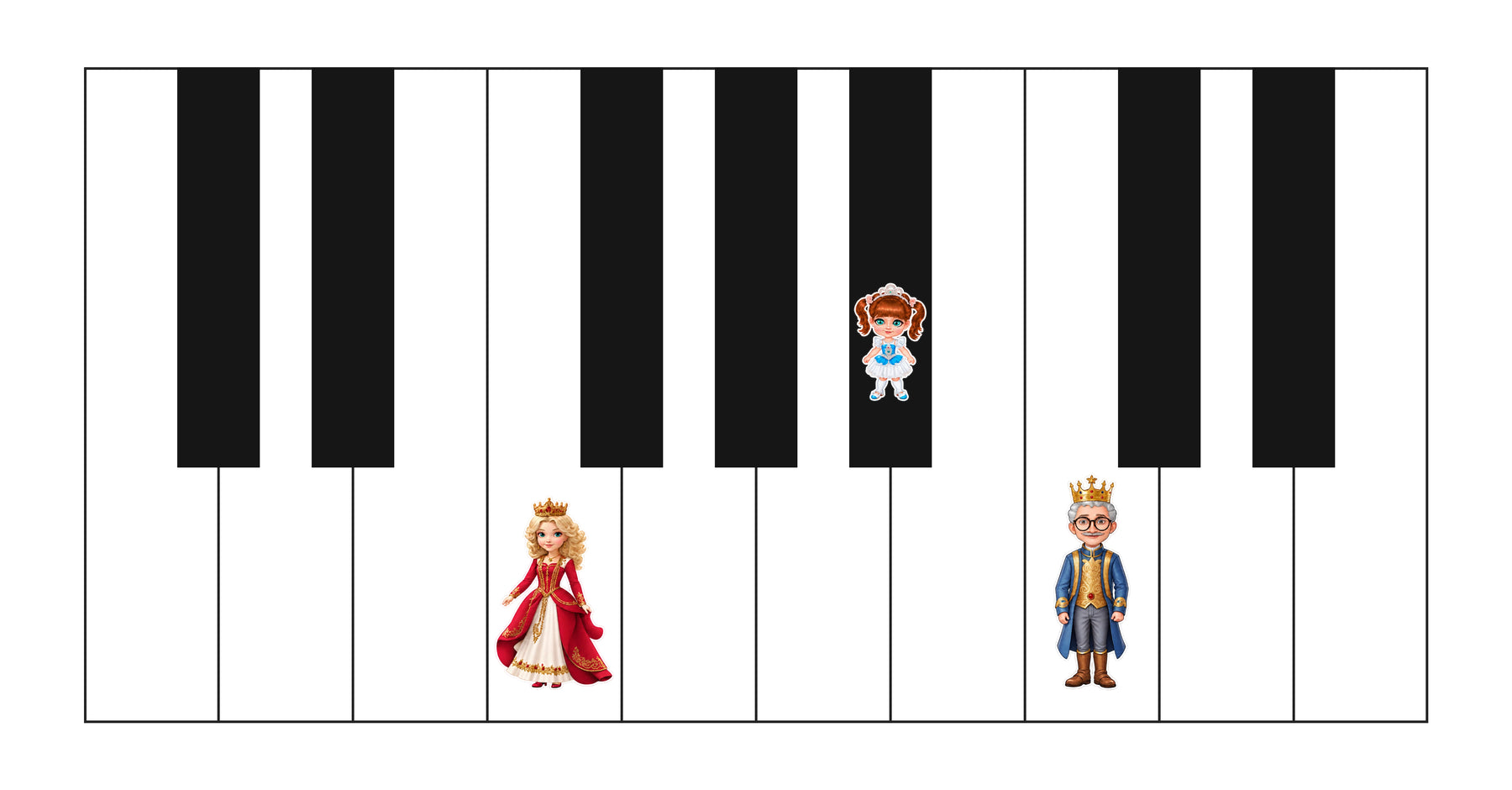
Find F, B♭, and C. Play F and C together. Then play B♭ and C together. The second sound is sharper and less settled in this context. Return to F and C and listen for the change. Can you hear the difference between a stable sound and a sound that invites you to move on?
Can you hear the melody come home to F at the end of Happy Birthday?
What to notice
Can you hear the difference between a stable pair of notes and one that creates tension? We are naming scale degrees and combinations of sounds here. One scale degree on its own is not a whole chord.
Meet the inhabitants of the Kingdom of Tune and Harmony

In the full course you will meet the other characters through songs, stories, and interactive games. Listen for the particular role each one plays in a melody. Knowing seven names is only the beginning: the goal is to recognize the relationships by ear and use them when you play.
Demo · 45 seconds
Try every available level in Guess Key. Compare scores over the same 45 seconds at the same level and in the same mode.
Practice with Guess Key
You will meet other Kingdom of Tune characters in the full course and in Guess Key. The game helps you connect what you hear with where the keys are under your hands.
Guess Key
Pitch, aural memory, and finding keys by touch
1. What it develops
Recognize pitch and connect what you hear to a key. Gradually find familiar keys by touch.
2. How hearing, vision, and movement work together
Repeated practice links the pitch you hear with the touch and movement you use to find it. Reduced cues give you more practice relying on the sound. [1] [2]
3. What to do
Try every demo level. Press 0 to remove the immediate cue, then try Night mode for listening practice. Look at your hands less as the layout becomes familiar.
4. What to avoid
Avoid random key presses and relying on sight for every answer. Listen before you choose.
5. What to notice
Compare your scores over the same 45 seconds. Can you find the keys by sound and touch with less looking?
3. Fine motor skills and coordination
Reading Builds Technique
It is often assumed that a student must train the fingers and master the correct hand position before beginning to read music. In Soft Way to Mozart®, learning to read and developing technique begin together. Your first musical action already has a purpose: produce the sound you see on the page.
In Soft Mozart, technique develops alongside music literacy. Reading a note and finding the key already calls on the eyes, brain, fingers, and ears. The action continues as you hold the note for the required length, release it, and prepare for the next sound.
The eyes locate a note, the hand finds the key, and the ear checks what happened. You must then hold the key for the written duration, release it on time, and prepare the next movement. In this way reading becomes a means of directing movement.
What research tells us
Research on adults learning music describes how practice brings auditory and movement processes together. Tempo and movement order also affect forearm muscle activity. These studies help explain the practice mechanisms behind the exercises. They examined music learning more broadly. [1] [2] [7]
How Gentle Piano supports movement
1. Make the position of the note clear
The interactive score helps you connect a note’s position with its key. You can make your first musical movement before memorizing a long list of rules. As you spend less attention searching, you can attend to the accuracy of the movement and the quality of the sound.
2. Learn to start, sustain, and end a sound
Finding the right key is the beginning. Follow the whole sequence:
- Find the key.
- Press it.
- Hold the sound for the length the score requires.
- Release it at the right moment.
The rose, butterfly, Mr. Oops, and spider give visual feedback. You can see when you have pressed the wrong key and when you have released the right one too early.
3. Develop independent finger movements
The fingers are connected anatomically and functionally. Some movements will come more easily than others at first. Learn to select the finger you need and guide its movement gradually. Notice unnecessary effort before it becomes part of the gesture.
4. Bring the two hands together gradually
Choose R for the right hand, L for the left, or P for both. When you play one hand, the program can play the other part. You hear the whole piece even while you are learning only one part of it.
5. Isolate a short passage
When you hesitate at one transition, select that part, repeat it, then reconnect it to the piece. Starting at the beginning every time gives the easy passages most of your practice time.
6. Measure progress on a repeatable task
Gentle Piano shows the number of notes credited and the visual–motor delay. This measures the time the program waited for your response. It does not directly measure how fast your fingers move. [9]
Play the same passage twice without changing the settings. If the notes remain accurate and the waiting time falls, you have evidence of progress on that particular task.
7. Gradually reduce visual support
The six presentations move from interactive visual cues toward conventional staff notation. When a passage is familiar, hide the notes to see how much you can play from memory. Reading, hearing, movement memory, and playing technique can then develop together.
Practice 1. Five Fingers
Watch the demonstration at 75% speed. Play right hand first, then left, then both hands. Find another C and repeat in a different register. Say the note names or count the finger numbers. Notice which fingers move comfortably and whether your coordination holds in the new register.
What to do
Try right hand, left hand, then both hands. Find another C and repeat in the new register. Say the note names in solfège or count the fingers.
What to avoid
Do not gain speed by tightening your hand.
What to notice
Which fingers move freely? Where do you need more attention? Does your coordination hold when you change registers?
When you are comfortable at the slower speed, try the regular tempo. Let the timing improve as the movement becomes easier.
Practice 2. Whispering Wind
Three white keys and two black keys
This chromatic exercise uses five keys from C to E: C, C♯, D, D♯, E. Use the thumb (1) on the three white keys and the middle finger (3) on the two black keys. Play 1–3–1–3–1, then reverse directions. Work hands separately at first.
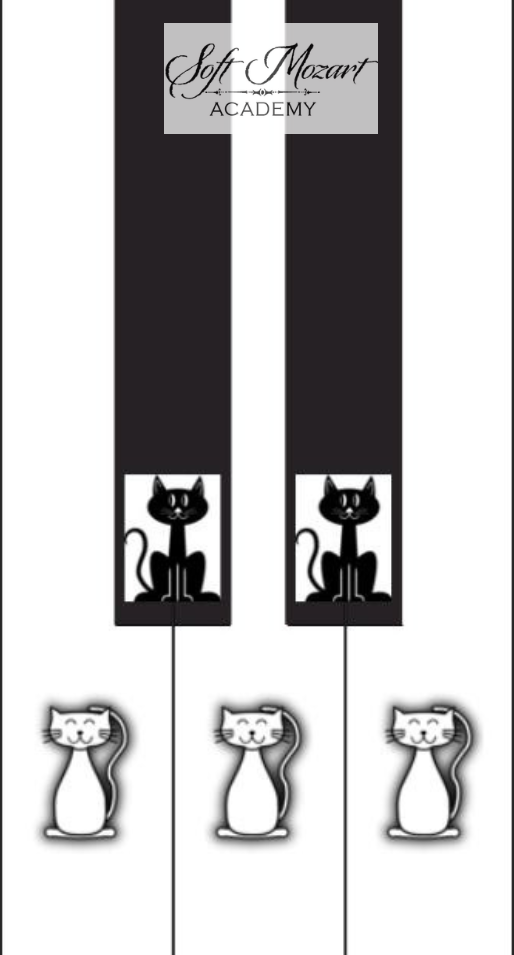
Find each key slowly. Once the pattern is steady, listen to the introduction to the accompaniment and find your entrance. Continue at a comfortable speed if you lose your place, then try again.
Work out the motion first
Find C, C-sharp, D, D-sharp, and E. Move slowly from one to the next, alternating thumb and middle finger according to the color of the key. Reverse direction. Learn the motion separately with each hand.
What to avoid
Wait until your fingers can find their keys reliably before increasing speed. If you lose the accompaniment, resist the urge to rush to catch up. Recover the steady motion and try again.
Play Whispering Wind with the orchestral arrangement
Watch the demonstration and then join the accompaniment. Listen to the introduction, time your entrance, and repeat the recording as needed.
- Play with your right hand three times.
- Play with your left hand three times.
- When both hands are comfortable on their own, try both hands together three times.
What this develops
Moving between white and black keys, alternating thumb and middle finger, finding your way on the keyboard, controlling each hand separately, coordinating both hands, and fitting your movements to an accompaniment.
What to notice
Which hand finds the black keys more easily? Can you switch between fingers 1 and 3 without extra effort? Can you stay with the backing track while keeping the movement easy?
Your first musical achievement
Playing the pattern three times with both hands and the accompaniment is a meaningful first result. Record an attempt so you can compare it later or share it with friends or the Soft Mozart community.
You need not wait for a perfect performance before recognizing what you have achieved. Revisit your recording after your next practice session. Reading Builds Technique: attentive musical practice helps a new movement become a dependable playing skill.
4. Music theory and ear training
Use 45 seconds for each attempt
For Guess Key and Fruit Lines, explore every demo level available. Compare your scores at the same level, in the same mode, for the same 45 seconds. In Note Duration, use the same melody too. Press F1 to check the controls for each game.
Guess Key is in the Kingdom of Tune and Harmony section. Here you will continue with duration, the order of note names, lines and spaces, and reading both clefs.
Warm up with the musical alphabet
Sing the note names with the video. Choose the cards that match the naming system in your settings. In American English note naming, the note Ti is written as B.
Note Duration
Start, hold, and release the note
1. What it develops
Feel note length by coordinating when you start, hold, and end a sound.
2. How hearing, vision, and movement work together
Sound and the movement of the note connect a timing judgment with an action you can repeat. [3]
3. What to do
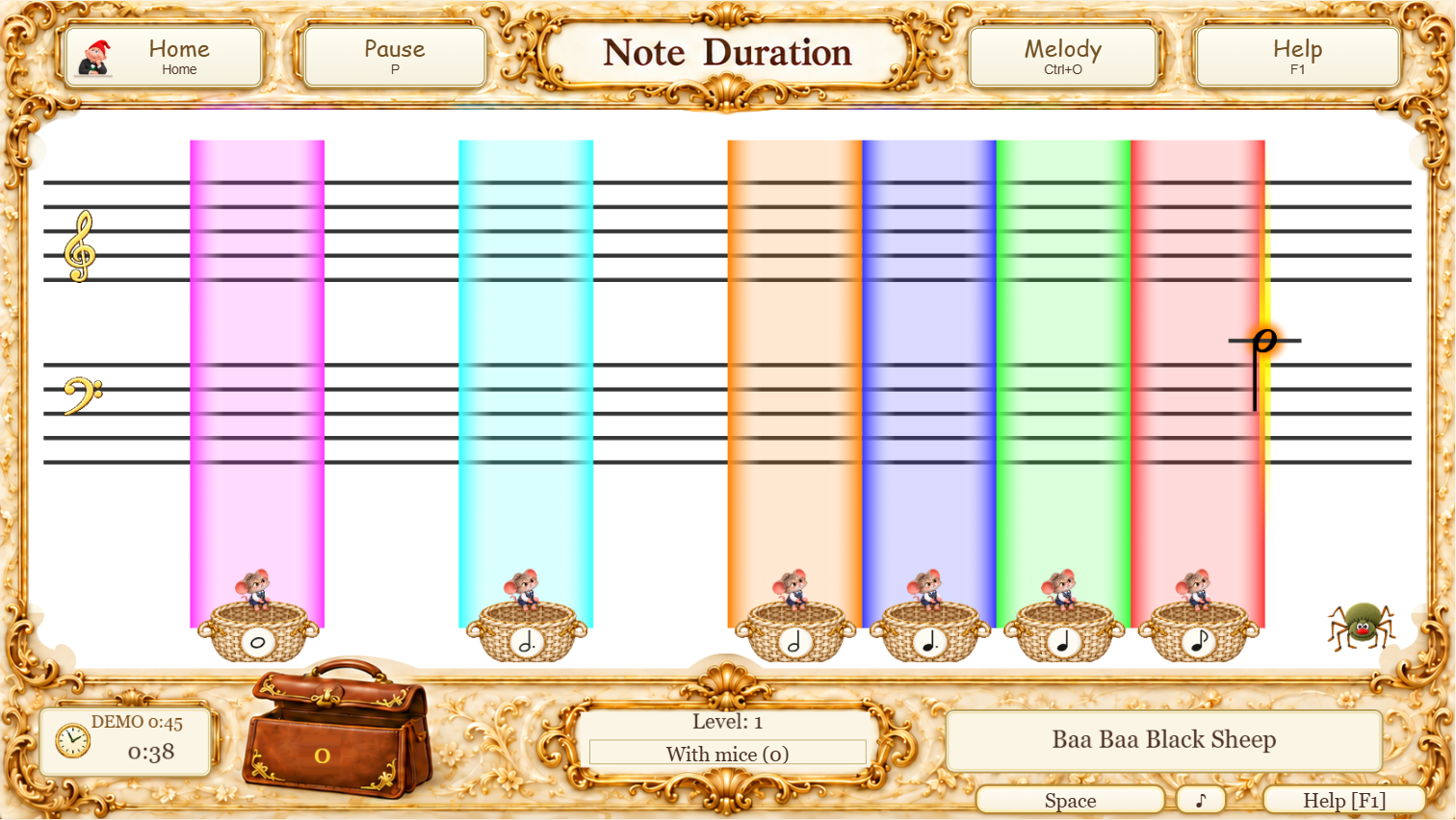
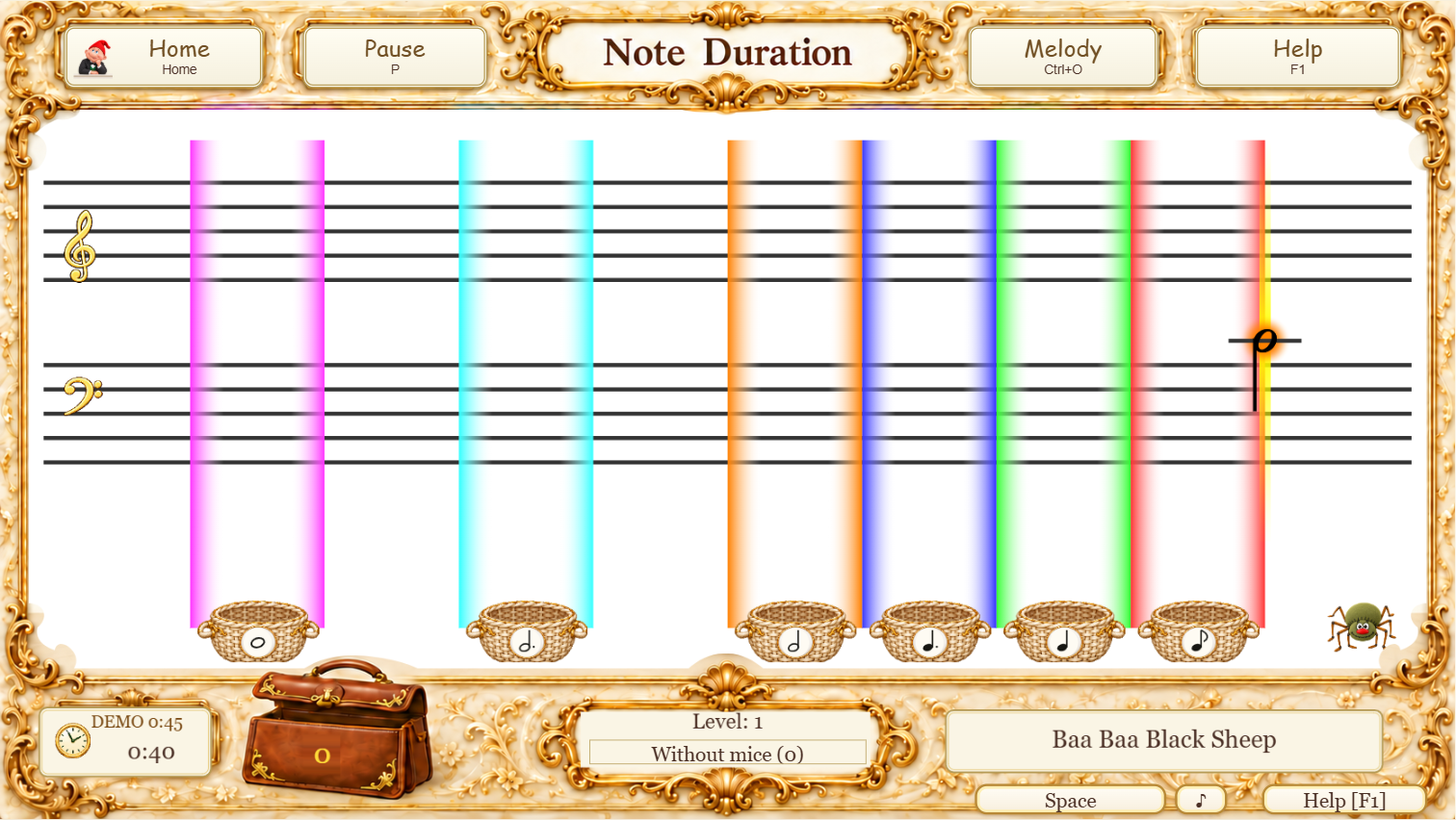
Press the spacebar at the yellow line, hold it, and release over the basket for that note value. Repeat without the mice by following the symbols and listening.
4. What to avoid
Do not substitute a series of short taps for one sustained press. Avoid releasing the key before the note has lasted its full duration.
5. What to notice
Compare scores for the same tune over 45 seconds. Can you hold the sound and choose your release point independently?
Start with the mice for visual support. Repeat without them and use the note values and sounds to decide when to release.
Note Alphabet
Find the next or previous note from any starting point
1. What it develops
Learn the order of note names in both directions.
2. How hearing, vision, and movement work together
Placing a note in a sequence turns recall into a spatial task. [4]
3. What to do
Use the arrow keys to put the falling note in the right place. Check the neighbors in both directions, starting on different notes.
4. What to avoid
Avoid starting on C every time or always reciting in one direction.
5. What to notice
After 45 seconds, record your score. Can you find the next or previous note without reciting the whole sequence?

Fruit Lines
Staff lines, spaces, and octaves
1. What it develops
Identify a note by its position on a line or in a space. As the range expands, recognize octaves and ledger lines.
2. How hearing, vision, and movement work together
The game connects a note’s location with its name. Those spatial relationships support later reading of intervals and chords. [5]
3. What to do
Try every demo level. Identify the note and its octave, move the correct basket into place, and speed up the fall once you have chosen.
4. What to avoid
Do not rush the basket into place before identifying the line or space and checking the octave.
5. What to notice
Compare scores for the same 45 seconds and level. Are lines, spaces, octaves, and ledger lines becoming easier to distinguish?

Treble Staff Puzzle
Place notes on the treble staff
1. What it develops
Find the position of a note in treble clef. Later, extend that skill to other octaves and ledger lines.
2. How hearing, vision, and movement work together
The game reverses the question. You see a note name and work out where it belongs on the staff. [6]
3. What to do
Use the arrows to guide the note to the right line or space. When the same note returns, see if you recognize its location.
4. What to avoid
Do not trade correct placement for speed. Check the line or space and octave before accelerating.
5. What to notice
Compare 45-second scores. Can you choose the position independently, with the octave in mind?

Bass Staff Puzzle
Place notes on the bass staff
1. What it develops
Read the bass clef and prepare to work with both staves.
2. How hearing, vision, and movement work together
Working with the bass staff separately lets you connect note names, spatial positions, and actions in this clef. [6]
3. What to do
Place the notes on the bass staff. Record your results separately from Treble Staff Puzzle.
4. What to avoid
Avoid using treble-clef positions by habit. Read the note in bass clef and give each clef regular practice.
5. What to notice
Compare scores over the same 45 seconds. Are you taking both the clef and octave into account?
After your attempts
Write down one improvement and one difficulty. You will use these skills together in Gentle Piano when you play Happy Birthday.
5. Playing the piano: Happy Birthday

Gentle Piano
Happy Birthday, from reading the score to playing with the orchestra
Bring note reading, movement, and listening together in Happy Birthday. The goal is to learn the tune and play it with an orchestral arrangement. In this lesson you use the web demo. The full course sequence is available in Soft Mozart 5.
What you are practicing
You are practicing accurate key presses, holds, and releases, as well as reading, memory, and coordination. With the orchestra you also listen for the entrance, keep a shared pulse, and coordinate your part with the others.
How hearing and movement work together
Studies of adult piano practice describe changes in how hearing and movement work together. Gentle Piano gives you time to find the key, practice one hand or a short passage, and later play with the notes hidden. Gradual increases in difficulty give you time to notice how comfortable the movements are. [1] [7]
Gentle Piano waits for the required key so that you can connect the note you see to a movement of your own. The flower and butterfly let you see how long to hold the key. Practicing one hand or a short passage lets you concentrate on one difficulty at a time.
Tempo and the order of movements affect forearm muscle activity. Increase the demands gradually, watching for comfort in the movement as well as accuracy in the sound. [7]
Start with a first attempt
Choose Happy Birthday and press F1 to see the controls. Listen to the piece. In the first score view, try the right hand, then the left, then both if you are ready. Write down what happened in each first attempt.
Use the thermometer to choose your next step
The thermometer reflects visual–motor delay, the time the program waited for the actions the score requires. Look at the color together with the credited notes and any errors. [9]
| Reading | What to try next |
|---|---|
| Green with steady accuracy | Try putting the hands together, lengthening the passage, or reducing the visual support. |
| Yellow | Repeat with the same settings and find the place where you hesitate. |
| Red | Shorten the passage, use one hand, or return to a familiar score view. Try again. |
When you change the hand, passage, view, Focus setting, or memory mode, take a fresh baseline. Check comfort separately. The thermometer does not measure muscle tension. Notice whether your shoulders rise, your hand stiffens, or you hold your breath. Pause when you need to. [8]
Hold each note for its full length
Hold the key while the flower opens and release when the butterfly appears. The spider shows a wrong key. If Mr. Oops appears, press the key again and hold the sound for the time that remains. As you find notes more readily, pay attention to fingering and smooth transitions.
If a transition feels awkward, ask a teacher to help you choose a comfortable fingering.
Isolate a passage
Use the arrow keys to move to the start of the passage and press Ctrl+Enter. Move to the end and press Ctrl+Backspace. Practice the section with each hand and then together. In the web demo, the spacebar clears the selection.
Repeat the same passage with the same settings. Look for more credited notes and less waiting. Once a transition is steady, reconnect it to the piece. Take a new reading when you put the hands together.
Try all six score views
Use a short, familiar passage. Press the number for the view and 0 to toggle the corresponding setting. In views 1–5, try Focus ON, then Focus OFF. In view 6, try the color cues first and then turn them off to recognize notes by their staff position.
| Score views | Order and purpose |
|---|---|
| 1, 2, 3, 4, 5 in turn | First turn Focus on: the notes approach the focus line. Then turn Focus off and track their position in the score yourself. |
| 6 | Start with the color cues, then switch to conventional notation. Check that you can follow the same short passage in both settings. |
Suggested sequence
1 → 1, 0 · 2 → 2, 0 · 3 → 3, 0 · 4 → 4, 0 · 5 → 5, 0 · 6, 0 → 6. Check the displayed Focus setting or color cues as you switch.
After switching score views, compare your result with another attempt in that same view and with the same Focus setting. To practice from memory, select the hand or hands first, then press H.
Try playing from memory
On a familiar passage, choose R, L, or P and press H to hide the notes for the selected hand or hands. Press V to bring the score back. If you get stuck, look at the passage again, practice it, and try recalling it once more.
Compare memory attempts with other memory attempts. When a short passage is secure, join it to the next one and work toward playing the whole tune without the screen prompts.
Play with the orchestra
Select the slow arrangement, listen to the introduction, and find your entrance. Play the complete tune three times with your right hand, three times with your left, and then try three times with both. Move toward concert tempo when you can play steadily with the slower arrangement.
Listen to the orchestra and notice how freely you move. If you keep losing your place at the same point, go back to that transition in Gentle Piano and use accuracy and the thermometer to check it. Record one attempt for yourself or to share.
What to avoid
Do not increase speed at the expense of accuracy or ease of movement. Rushing to turn the thermometer green can reinforce an awkward gesture. Change only one condition at a time: hand, passage, score view, or tempo.
Do not hold your wrist and fingers rigidly for the sake of a hand that looks correct. Check your seating and hand movement while you play. Take breaks and stop if playing hurts. If pain returns, consult a qualified professional. [8]
What to notice as you repeat the task
For timed scores, keep the duration the same. For a complete passage, compare the credited notes and waiting time with the same passage, hands, tempo, score view, and Focus setting.
- Are there fewer wrong keys and stops? What does the thermometer show with the same settings?
- Can you hold and release on time with comfortable movements?
- Can you correct an error on your own, recall the hidden notes, and hold your part with the orchestra?
- Can you hear the return to F, the tonic?
Change one practice condition at a time, so you can tell what helped. Keep the pace comfortable, take breaks, and stop if playing hurts. A teacher can help you find an easier fingering or movement. [8]
Use the numbers together with what you felt and saw in your movements to choose the next step.
6. Musical culture and listening
Now that you have played Happy Birthday, listen to what performers and composers do with the tune. Your own experience at the keyboard gives you something familiar to listen for. [1]
What this develops
Practice remembering a melody, recognizing a theme, and following the relationship between melody and accompaniment. Learn to explain an impression by pointing to something another listener can hear.
How listening and memory work together
You hold the familiar tune in mind while comparing it with what you hear now. Having played the tune yourself gives you another point of reference: its sound is already connected to actions at the keyboard.
Hear the tune in another setting
Listen to Igor Stravinsky’s Greeting Prelude all the way through. Then listen again and see how the familiar tune appears.
Compare two or three other performances
Choose different versions of Happy Birthday, such as a vocal, piano, jazz, or orchestral performance. Save the links and the performers’ names. Pick one brief passage in each recording and write down its timestamp.
- Where does the melody stay recognizable while the tempo, tone color, dynamics, or accompaniment changes?
- Where does the theme itself change? Listen for a change in its rhythm or shape, the extension of a short motif, a variation, or an improvisation.
Describe what you hear in your own words. A change of instrument or key alone does not establish that the theme has been developed. A simple observation such as “this phrase repeats with a different rhythm” is enough to get started.
What to avoid
Go beyond “I like it” or “I don’t like it.” Find a musical reason for your impression. You do not need the technical name for every device: “the phrase comes back with a different rhythm” is a useful first observation.
What to notice
Can you distinguish a change in the accompaniment from a change in the tune itself? Give the time of a specific example and explain how the change affects the character of the music.
Share what you discovered
Post a recording, a comparison of two attempts, or one discovery from your listening on the Soft Mozart forum or on social media. Tell other learners how you practiced. Perhaps you worked one hand at a time, used a shorter passage, changed score views, tried memory mode, or played with the orchestra. Say what changed and what you want to try next.
Tell other adults and parents how you learned the piece. Describe how you used accuracy and the thermometer to choose a task, worked in sections, played hands separately, switched score views, practiced from memory, and joined the orchestra.
Explain how you adjusted the difficulty to the learner while also watching for excess effort, comfortable seating, and freedom of movement. These observations help a beginner understand both the result and how it was achieved. The thermometer can guide the choice of task. A teacher can help with hand position and movement when needed.
Research and references
The sources describe general processes in learning and musical practice. The lesson uses those findings to explain how its exercises are designed.
- Bangert M., Altenmüller E. O. (2003). Mapping perception to action in piano practice: a longitudinal DC-EEG study. BMC Neuroscience 4, 26.
- Lappe C. et al. (2008). Cortical plasticity induced by short-term unimodal and multimodal musical training. Journal of Neuroscience 28, 9632–9639.
- Teki S. et al. (2011). Distinct neural substrates of duration-based and beat-based auditory timing. Journal of Neuroscience 31, 3805–3812.
- De Belder M. et al. (2015). Serial Position Markers in Space: Visuospatial Priming of Serial Order Working Memory Retrieval. PLOS ONE 10, e0116469.
- Wong A. C.-N. et al. (2019). Visual training with musical notes changes late but not early electrophysiological responses in the visual cortex. Journal of Vision 19(7), 8.
- Stewart L. et al. (2003). Brain changes after learning to read and play music. NeuroImage 20, 71–83.
- Chong H. J., Kim S. J., Yoo G. E. (2015). Differential effects of type of keyboard playing task and tempo on surface EMG amplitudes of forearm muscles. Frontiers in Psychology 6, 1277.
- BAPAM. Return to Play: guidance for musicians returning to playing.
- Soft Mozart. The importance of eye–hand span measurement in music education.
- Worschech F. et al. (2023). Fine motor control improves in older adults after 1 year of piano lessons: Analysis of individual development and its coupling with cognition and brain structure. European Journal of Neuroscience 57, 2040–2061.
- The Open University. An introduction to music theory: degrees of the scale.
- Peterson J. Open Music Theory. Introduction to Harmony, Cadences, and Phrase Endings.
Open a practice module
For a repeatable trial, record your settings and score. Play each theory game for 45 seconds. In Guess Key and Fruit Lines, try every available demo level. Compare scores at the same level and in the same mode.
Note Duration
Note Alphabet
Fruit Lines
Treble Staff Puzzle
Bass Staff Puzzle
Gentle Piano
Continue learning with Soft Mozart
Save your results and choose one small step to work on next. The full course brings together step-by-step lessons, new pieces, songs, games, and stories from the Kingdom of Tune.