
Preparatory C (from 5+). Lesson 38

Your FREE Demo version is here
Your full version access is here
Why is classical music so important for the development of our children?
Classical music is able strengthen the quality of a child’s attention, to awaken in him or her the perception of the spiritual beauty of the world, to develop intelligence and creativity in each person.
Masterpieces of classical music help little men or women realize their own purpose, spiritual significance and uniqueness. In children, they strengthen confidence in their strength and understanding of themselves as a unique part of the overall harmony.
That is why classical music, the musical thoughts from the masterpieces of world art, as the thought of spiritual abstraction of a higher order, can greatly develop the memory and thought processes of any person starting from early preschool age.
Why is this possible only with classical music?

Classical music leads the way and raises the soul of the child, like engineering designs of water create beautiful fountains. It elevates the perception of the world, leads the child away from concentrating solely on physiological desires and needs.
In classical music, there is a theater with its intrigue, development, main and secondary images.
So, for example, the sonata form offers the listener not one primitive motive and not one musical phrase, but several. But this is not the main thing! In classical music, even the simplest phrases evolve; in pop music, they stay the same.
Moreover, in simple terms, in classical music . . . more notes. And more different nuances in the presentation of these notes. A child learns to listen, to be able to distinguish between intonation, timbre, interpretation of musical images. His or her relationship with the sounds ceases to be thoughtless.
Such music requires a much greater concentration of attention, efforts of will, consciousness, an ability to react and respond to the sounds of the world. And then the child’s soul chooses what it needs for growth and understanding.
click on the picture and watch the video:

The ability to hear . . . Does this not require today to teach us different languages? And not only languages! The ability to communicate with others is based on the ability to hear and understand sounds. Vibrations, intonation, voice, timbre, breathing are often much more truthful than the picture. Without the ability to hear the beautiful uplifting sounds, the child is denied access to understanding the world’s harmony.
Listening to classical music involves, in the process of listening, the ability to analyze material (compare individual intonations, melodies and harmonic turns), feel them (respond to the moods conveyed in music) and remember (be able to recognize intonations, melodic and harmonic turns) simultaneously. It is invaluable for the development of each baby, both hemispheres of his or her brain.
1. Improving the playing of the C Major scale with separate and two hands with a metronome. We play a little faster than last week. We try to play even sounds, remember the exercises of O.M. Egorova and watch your hand and elbows.
2. If possible, repeat the exercises of the previous lessons.
1.The book "Kingdom of Tune"
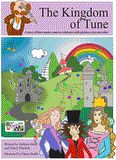
We continue to get acquainted with the history and color the pictures.
2.Cards "I read music" Level 1

We continue to work with cards - find out where the notes are boys and where the girls are.
Check the answer on the back of the card
Video example:

If your child is growing faster or slower than our plans suggest, we encourage you to contact us at admin@softmozart.com to start learning with our certified professionals.
1.  Gentle Piano®- Reading from a sheet. First Steps: Drummer
Playing R, L and P on 2, 4, 5, 6
2. Gentle Piano®- A piece to perform - "Cat Boogie"
Learning R, L and if possible P
3. We continue to improve the performance of the piece "Robot Rock" with and without a computer.
We record a video performance of the play for publication in the progress diary.
M. Ravel "Bolero"
TEASER: Gentle Piano® - download LMZ file of a more complex version of the work.
Learning to play the left hand L - you can play the part of the left hand with both hands.
Video of the orchestral performance from the Internet:
Visit our Soft Mozart forum and start your progress diary here. Use the current year section. This is the place for you to ask questions and share your experiences.
At least 2 photos and 1-2 videos of the listed activities will count towards your child's credits for the graduation DIPLOMA. Please upload the video to You Tube, copy the address from the BROWSER window and paste it into your Progress Diary. Do not forget to indicate the year and type of work in the description of your Soft Mozart Academy photo / video.
Sincerely Yours,
Hellene Hiner

Video success:
 Would you like to receive lessons by email weekly? Subscribe to the e-mail lesson here:

All the lesson plans:
For 2+ students
For students from 3 to 5
For students 5+
Always check here, if we have any recital! You and your child will benefit a lot from participating in our concerts!
Your place to start your progress diary is here.