
Portfolio

Reading Music
from the Beginning
Results, Research & Recognition
Documenting how early practical music reading develops into long-term musicianship.

From Pedagogical Research to Musical Literacy

Hellene Hiner
Soft Way to Mozart® grew from a pedagogical investigation into a fundamental problem of music education: why does practical reading of the musical score remain difficult for so many beginners?
The work developed from teaching materials into an interactive system connecting notation, keyboard orientation, hearing and physical coordination. It was followed by public recognition, academic publication, scientific conferences, professional development for educators and long-term student outcomes.
Conventional music instruction commonly begins by teaching notation as a symbolic system that must be decoded. Soft Way to Mozart® approaches the score as a practical language from the beginning, developing reading, playing, hearing, visual orientation and coordination together.
Research & Recognition

Published in How to Teach Solfeggio in the 21st Century.
Research with Irina Gorbunova, Mikhail Zalivadny and Kirill Plotnikov on music-computer technologies and digital-age music education.
Oxford · CSIS · Cebu · Istanbul · EPTA.
Professional development in interactive music education using Soft Way to Mozart®.
Wensheng Ruan of Hubei Polytechnic University conducted an independent comparative study of piano learning using Soft Mozart.
Educational possibilities of Soft Way to Mozart in music-teacher preparation.
DOI 10.51889/2959-5762.2025.88.4.020Contemporary music-pedagogical work with preschool children with autism spectrum disorder.
DOI 10.30853/ped20250030Adaptation strategies and structured music lessons in inclusive preschool education.
DOI 10.30853/ped20250069University-level research incorporating Soft Way to Mozart, Gentle Piano and Note Alphabet into practical music reading.
European Scientific e-Journal · No. 39 · pp. 120–134DOI 10.61726/2419.2025.97.57.001
Professional development included a 24-hour course in interactive network technologies of music education using Soft Way to Mozart®.
University materials documented the experience as being practiced in 60 countries.
Individual elements of the Program may be recommended for preschool educational institutions and for use in music lessons in the primary grades of general-education and special-education schools.English translation of the relevant conclusion from official correspondence dated July 12, 2013. Follow-up correspondence dated November 20, 2013 transmitted the earlier response.
Complete Academic Bibliography
2006 — Hiner, E. “Computer Path to Mozart.” How to Teach Solfeggio in the 21st Century.
2014 — Hiner, E. “Experience of Implementing the Soft Way to Mozart System in World Music Education...”
2014 — Gorbunova I.B., Hiner E. “Interactive Network Technologies of Music Education in the Digital Age School: Soft Way to Mozart.”
2014 — Gorbunova I.B., Zalivadny M.S., Hiner E. “Music-Computer Technologies as an Information and Transmission System in the Digital Age School.”
2015 — Gorbunova I.B., Zalivadny M.S., Hiner E. “On the Significance of Mathematical Methods in Music Research and Professional Musician Training.”
2017 — Hiner, E. Inclusive Music Education: Methodological Recommendations for Applying Soft Way to Mozart for Children with Special Needs.
2018 — Hiner, E. “Basic Characteristics of Attention and Effective Ways of Developing It in Children.”
2018 — Hiner, E. “Motivation as an Important Factor in Successful Music Learning.”
2018 — Hiner, E. “Respect for the Student and Soft Learning as Main Principles of Music Teaching.”
2018 — Gorbunova I.B., Hiner E. “Music Education Today: Music Computer Technology System for Learning Music Soft Way to Mozart.”
2018 — Gorbunova I., Hiner H. “Music Computer Technologies and Interactive Network Systems of Learning Music.” Oxford.
2019 — Gorbunova I., Hiner H. “Music Computer Technologies and Interactive Systems of Education in Digital Age School.” DOI 10.2991/csis-18.2019.25
2019 — Hiner H., Gorbunova I.B. “Music Computer Technologies in Music Studies at School of the Digital Age.” DOI 10.17758/ERPUB3.UH0119404
2019 — Hiner H., Gorbunova I.B. “Music Computer Technologies and the Soft Way to Mozart System.” DOI 10.17758/ERPUB3.UH0119403
2019 — Gorbunova I.B., Hiner E. “Music Computer Technologies: Music Education in Digital Age School.”
2020 — Gorbunova I.B., Plotnikov K.Yu., Hiner E.V. “Music-Computer Technologies as an Interactive Network Educational Environment.”
2022 — Hiner H., Harper N.L. “Vertical Reading: The Soft Mozart™ Way.” Piano Journal, Issue 58.
2024 — Hiner H., Harper N.L. “A Millennium, a Medieval Treatise, and a Modern Method of Music Literacy.” Piano Journal, Issue 132.
2024 — Hiner H., Gorbunova I.B. “Guido d’Arezzo’s Musical Notation and Their Significance in the Development of Musical Pedagogy through Interactive Digital Technologies.” DOI 10.17758/URUAE23.UA0524404
2024 — Wensheng Ruan. “Increasing Student Motivation to Learn the Piano Using Modern Digital Technologies: Independent Piano Learning with the Soft Mozart App.” Current Psychology. DOI 10.1007/s12144-024-06924-3
2025 — Mariach A.Yu. “Features of Organizing Music Classes with Preschool Children with Autism Spectrum Disorder...” DOI 10.30853/ped20250030
2025 — Mariach A.Yu. “Modeling Music Lessons as a Strategy for Adaptation of Preschool Children with Autism Spectrum Disorders...” Pedagogy. Theory & Practice, Vol. 10, Issue 5. DOI 10.30853/ped20250069
2025 — Mariach A.Yu. “Fostering Students’ Independence in the Context of Musical-Instrumental Training at a Pedagogical University.” European Scientific e-Journal, No. 39, pp. 120–134. DOI 10.61726/2419.2025.97.57.001
2025 — Kulmanova Sh.B., Urazaliyeva M.A., Sultanova M.S., Baribayeva A.S. “Educational Possibilities of the Computer Technology Soft Way to Mozart in Music-Teacher Training.” DOI 10.51889/2959-5762.2025.88.4.020
A New Generation of Musicians
Each trajectory begins with a documented early point of contact with Soft Mozart and practical music reading, followed by the musical development that came later.
Soft Mozart · Age 3  Later
Later  Katarina “Katya” Gervits Soft Mozart from age 3. Teacher: Lyubov Yanpolskaya — certified Soft Mozart educator, personally trained and certified by Hellene Hiner. Television · International competitions · Orchestra
Katarina’s early Soft Mozart work is documented on video from age three.
- 2012 — Piano Forever Competition: Encouragement Prize
- 2013 — Golden Keys Competition: First Prize
- 2013 — Piano Forever Competition: Encouragement Prize
- 2014 — Golden Keys Competition: First Prize
- 2014 — Piano Forever Competition: Second Prize
- 2014 — International Piano Competition, Belarus: Second Prize
- 2015 — Piano Forever Competition: Second Prize
- 2016 — International Chopin Piano Competition, Narva: Special Prize
- 2017 — Piano Forever Competition: Third Prize
- 2017 — Scherzo International Piano Competition: Second Prize
- 2018 — AICF Scholarship Award
- 2018 — Fiestalonia Israel: Bronze Diploma, Solo Piano
- 2018 — Fiestalonia Israel: Golden Diploma, Piano Four Hands
- 2018 — Scherzo: Second Prize, Solo Advanced
- Ashdod Orchestra performance
Soft Mozart · Age 4  Later
Later  Elizabeth “Liza” Gervits Soft Mozart from age 4. Teacher: Lyubov Yanpolskaya — certified Soft Mozart educator, personally trained and certified by Hellene Hiner. International prizewinner · Television · Orchestra
- 2011 — Piano Forever Competition: Encouragement Prize
- 2012 — Piano Forever Competition: Encouragement Prize
- 2013 — Golden Keys Competition: First Prize
- 2013 — Pnina Salzman Competition: Honorable Mention
- 2014 — Golden Keys Competition: First Prize
- 2014 — Piano Forever Competition: Third Prize
- 2014 — International Piano Competition, Belarus: Fourth Prize
- 2015 — Piano Forever Competition: Encouragement Prize
- 2015 — Pnina Salzman Competition: Third Prize
- 2016 — Piano Forever Competition: Second Prize
- 2016 — Chopin Competition, Narva: Special Prize
- 2017 — Piano Forever Competition: First Prize
- 2017 — Scherzo International Competition: First Prize
- 2017 — Pnina Salzman Competition: First Prize
- 2018 — AICF Scholarship Award
- 2018 — Fiestalonia Israel: Golden Diploma, Solo Piano
- 2018 — Fiestalonia Israel: Golden Diploma, Piano Four Hands
- Orchestral performances including Beethoven concerto repertoire
Early  Later
Later  Katarina & Elizabeth Gervits Started with Soft Mozart at ages 3 and 4 respectively. Teacher: Lyubov Yanpolskaya. Piano Duo · Four Hands · Television · Orchestra
- Early television appearances
- 2018 — Fiestalonia Israel: Golden Diploma, Piano Four Hands
- 2018 — Scherzo Competition: Second Place, Piano Four Hands
- Ashdod Orchestra performance
Age 7 · Kyiv · 2008  Later
Later  Tetiana Donets Documented at age 7 in Kyiv, 2008. During that period Hellene Hiner personally trained Tetiana’s mother and aunt in the principles and educational tools of Soft Way to Mozart®. Professional pianist · International prizewinner · Orchestra
Tetiana later studied at the Kyiv Special Music School and Jerusalem Academy of Music and Dance, including study with Prof. Oxana Yablonskaya.
- Kyiv Special Music School
- Jerusalem Academy of Music and Dance
- Puigcerdà Music Festival: Winner
- Duxbury Music Festival: Winner
- Rachmaninov Concerto Competition: Winner
- International Music Competition, Israel: Grand Prix
- Pnina Salzman Competition: Second Prize
- 2023 — Johannes Brahms Competition: Second Prize
- 2025 — Domenico Scarlatti Competition: Second Prize
- 2025 — Special Prize for Best Performance of a Scarlatti Sonata
- Arthur Rubinstein International Music Society: Junior Jury
- Orchestral appearances including Jerusalem Symphony Orchestra
Soft Mozart · Age 5  Later
Later  Arina Titova Started with Soft Mozart at age 5. Teacher: Olga Mikhailovna Egorova — certified Soft Mozart educator, personally trained by Hellene Hiner. Gnessin School · International competitions · Sirius
Arina worked with Soft Mozart from January 15, 2015 through mid-May 2016. During summer 2016 she continued intensive sight-reading with Gentle Piano.
She subsequently entered the Gnessin Moscow Special School of Music on a state-funded place and continued working with Olga Egorova alongside her professional studies.
- 2018 — Sozvuchie: Laureate, Second Degree
- 2019 — International Competition of Young Pianists, Riga: Third Degree
- 2022 — MUSICUS IUVENIS: First Degree
- 2023 — Con fuoco: First Degree
- Gnessin Moscow Special School of Music
- Sirius concert performance
Soft Mozart · Age 6  Later
Later  Alexander Beliakov de Felipe Started with Soft Mozart at age 6 in Madrid. His first teacher was Victoria López — certified Soft Mozart educator, personally trained by Hellene Hiner. Spain · Les Arts · Washington · New York
Alexander later completed professional and higher musical studies in Valencia and developed an active recital career.
- Sigüenza Competition: First Prize
- Amparo Fandos Competition: First Prize
- 2022 — Juventudes Musicales de España: Second Prize
- 2025 — Diploma of High Specialization: 9.5
- Palau de les Arts Reina Sofía
- Spanish Young Music Talents — Washington, D.C.
- Performances in Washington and New York
Soft Mozart · Age 2½  Later
Later  Ella Angeles Documented with Soft Mozart from age 2½. Her mother extensively documented Ella’s early development through the BrillKids community and the family video archive. Piano · Violin · Guzheng · Multi-Instrumental Development
At 31 months, after approximately one month of Soft Mozart work, Ella’s mother documented her playing simple pieces with both hands.
Her broader early-learning environment also included ear training and later Suzuki violin.
- Early practical piano reading
- Two-hand playing documented in toddlerhood
- Violin study and public performance
- Playing by ear and transposition
- Guzheng performance
- Cross-instrument musicianship
- Later public performance in a Stanford University setting
Soft Mozart · Age 4  Later
Later  Isaac Kuang Documented Soft Mozart student in Australia from age 4. Teacher: his mother, Esther Yeow. Music Reading · Solfège · Piano · Cello
Isaac’s early documentation includes practical sight-reading, solfège, Hanon, two-hand coordination, classical repertoire and work with different notation-presentation modes.
- Soft Mozart documented from age four
- Sight-reading and solfège
- Hanon and two-hand coordination
- Classical repertoire in early childhood
- Transition to cello
- Public stage performance
- Later repertoire includes Manuel de Falla
International Media & Historical Archive

“Soft Way to Mozart” and Hiner Method on TV and in publications worldwide
China
European Professional Press


Citizen K Magazine


Norway
Article about pianist, organist and piano teacher Valeri Rubacha.


Portugal
Spain
Israel
Kazakhstan
Mexico
Aguascalientes Presentation


Russia
Soft Mozart Show in Kemerovo Region

The Mayor of Kemerovo Region (Siberia, Russia) Marat Kallimulin with Hellene Hiner's Address Letter.


The Mayor of Kemerovo Region is trying the software before the show starts.

St. Petersburg

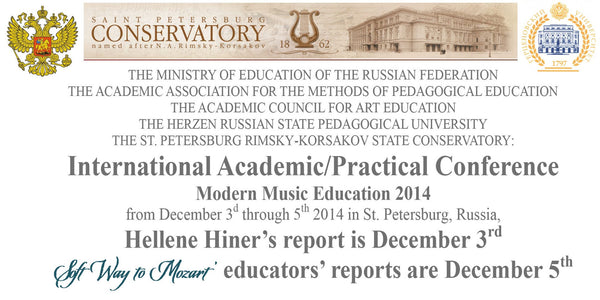
St. Petersburg: Herzen University & Conservatory Scientific Conference
Ukraine
Kharkiv National University of Arts Encyclopedia


United States
Piano Performer Magazine

The Hiner Method
Voyage Houston Magazine

Houston Chronicle · June 9, 2005
